contact@bars.org.in
Follow Us:
×

Bringing the right people, knowledge, and systems together!

BARS
Samaaj
Sarkaar
Bazaar

contact@bars.org.in

Fill in the Details!

+91

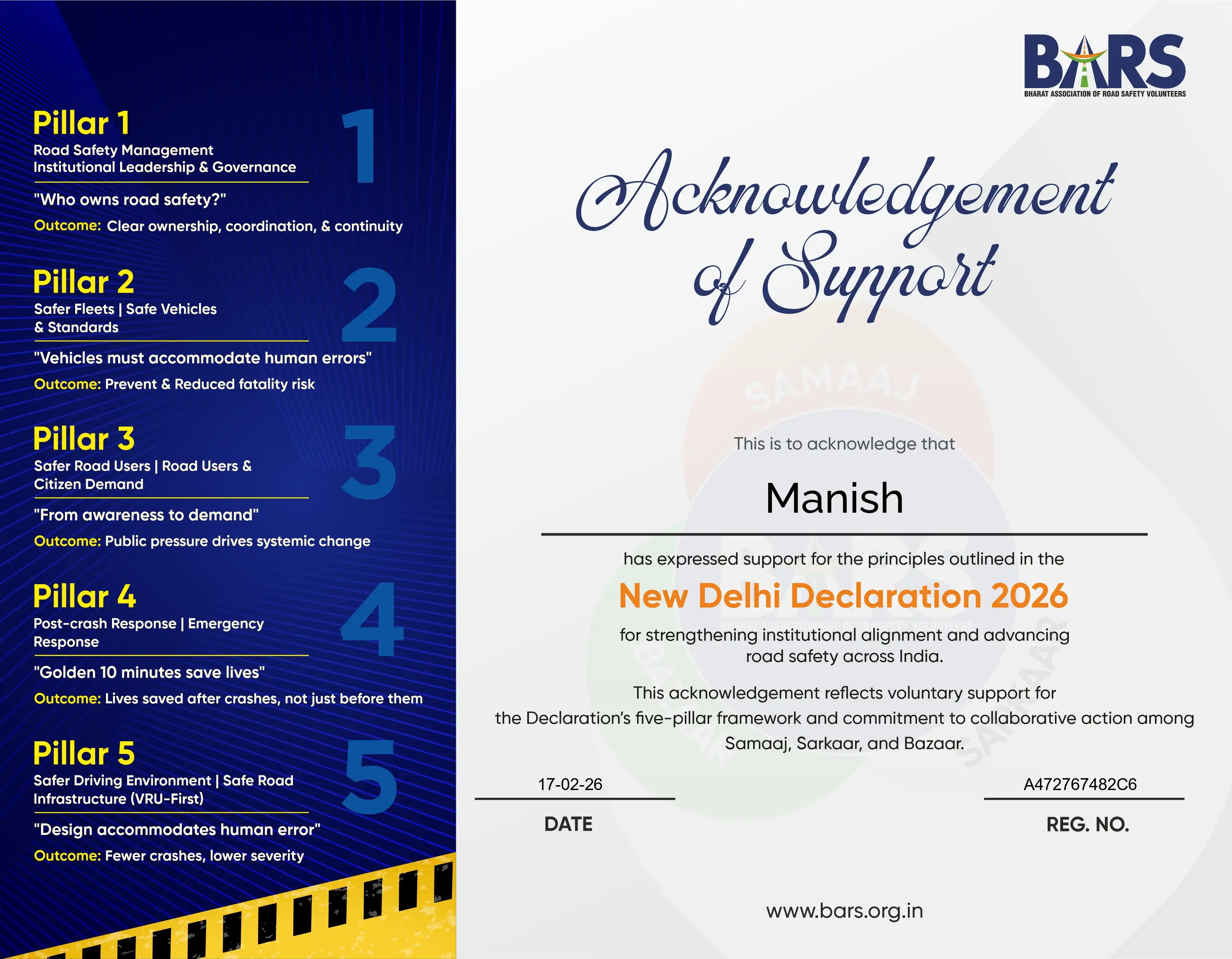
New Delhi Declaration

WHO-aligned. India-focused. BARS unites Samaaj, Sarkaar and Bazaar for safer roads.
Preamble

We recognize that road traffic deaths and injuries in India are preventable - not inevitable. Every life lost reflects our collective failure of systems, design, governance, enforcement, and compliance. Road safety is not merely a transport issue, it is a public health imperative, a development priority, and an essential component of Vikshit Bharat 2047.

We the undersigned Civil Society organizations, Public Health Advocates, Industry & Businesses, Volunteers, Road Safety Champions & citizens of this country belonging to Samaaj, Sarkaar and Bazaar, united in our commitment to saving lives and preventing injuries, reaffirm our strong support for the Global Plan for the Decade of Action for Road Safety, endorsed by the World Health Organization and the United Nations.

Declaration

Aligned with the global commitment to reduce road deaths and serious injuries by at least 50% by 2030, we commit to accelerating coordinated action in India through a Safe System approach – placing human life above speed, convenience, and commercial interest. We commit to independent monitoring and transparent public reporting of progress every year until 2030.

We call upon all institutions, leaders, and citizens to join this shared national responsibility as stated below.

01.

Road Safety Management

Institutional Leadership & Governance Outcome: Clear ownership, coordination, and continuity
  • Establish a strong National Lead Agency or equivalent with mandate & capability to conduct root-cause crash analysis and implement targeted corrective and preventive measures with urgency.
  • Integrate State Lead Agencies, District Road Safety Committees (DRSCs), and city bodies into one accountable operating framework with data driven hyper local interventions & transparent dashboards.
  • Commit to annual public progress reviews aligned with measurable reduction targets at District & State Level.
  • Ensure open, interoperable, and publicly accessible road crash data systems to enable research, accountability, and innovation.
  • Integrate road crash response within national and state disaster management frameworks in alignment with NDMA guidelines.
  • Ensure sustained, ring-fenced road safety financing aligned with risk exposure and vehicle density.
  • Deploy trained Fellows/Volunteers, full-time coordinators across all DRSCs (800+ districts) and traffic wardens, voluntary assistance to local enforcement agencies.
  • Strengthen enforcement capacity through adequate resourcing, training, and technology-enablement. Practice Graded penalty to repeat offenders up to cancellation of License.
  • Align insurance premiums and licensing frameworks with risk behavior through standardized point-based systems, incentives for compliance, and disqualification of repeat offenders.

Principle: Road safety must have a clearly identifiable owner & provision for requisite resources at every level of governance.

02.

Safer Fleets & Vehicles

Vehicles Must Accommodate Human Error Outcome: Prevent crashes and reduce fatality risk
  • Prioritise India-specific risk categories: 2-wheelers, 3-wheelers, buses, commercial and slow-moving vehicles need safer designs and strengthened stability.
  • Adopt Assist & Alert technologies (Poka-Yoke principles) to prevent predictable errors.
  • Enable secure, privacy-compliant access to connected vehicle data (V2V, V2X) for fleet safety enforcement.
  • Eliminate counterfeit and sub-standard aftermarket components.
  • Promote visibility and conspicuity solutions - sequenced as “Dekho-Ruko-Bacho.”

Principle: Technology and standards must compensate for human vulnerability.

03.

Safer Road Users & Citizen Demand

Compliance Precedes Demand for Safer Infrastructure. Outcome: Public pressure drives systemic reform
  • Embed road literacy, driving skills and life-saving protocols into education and habit formation through hackathons & Challenges themed on Road Safety (convergence with NEP in Schools)
  • Enforce speed management, helmet use, seat belts, and right-of-way compliance at national scale.
  • Leverage AI-enabled camera systems (street-facing and in-vehicle, public and private) and digital integration of V2V & V2X communications trails for crash research, predictive enforcement, skill improvement, and behavioral correction.
  • Road Safety to be included as legal component within HSE compliance for businesses, industries, manufacturing units and residential complexes. Embed road safety into ESG frameworks, supply-chain standards, and corporate governance disclosures.
  • Enable citizens to demand:
    • Safe and accessible crossings
    • Evidence-based speed limits
    • Night-time illumination and visibility
    • Dedicated infrastructure for Vulnerable Road Users (VRUs)
  • Shift narrative from “Who is at fault?” to “Where did the system fail?”

Principle: Compliance must evolve into cultural norm.

04.

Post-Crash Response

The Golden Hour of Saving Lives Outcome: Lives saved after crashes - not only before them
  • Build a Digital Public Infrastructure (DPI) for mobility safety, enabling secure crash detection, auto trigger, data integration, and coordinated response through open source protocol - like UPI, Namma Yatri etc.
  • Enable real-time crash alerts and unified emergency access.
  • Scale basic & standardized first-responder training across communities and fleets to make Rah-Veer scheme a national success.
  • Strengthen trauma care integration and seamless transfer protocols to make Cashless Treatment Scheme PM-RAHAT a National Success.
  • Strengthen research collaboration among academia, industry, and government to accelerate evidence-based innovation.

Principle: Survival should not depend on geography or luck.

05.

Safer Driving Environment

Infrastructure Designed for Human Error Outcome: Fewer crashes, lower severity
  • Design roads prioritizing pedestrians, cyclists, and two-wheelers.
  • Speed Management by Design, adopt safe system approach (Poke-Yoke).
  • Slow city speeds through road design - not signage alone.
  • Provide dedicated and segregated lanes for VRUs at high-speed corridors.
  • Reduce conflict points via compact intersections and safe crossings.
  • Ensure safe bus-stop placement and conflict-free institutional zones. Prioritize children, women, persons with disabilities, elderly citizens, gig workers, and rural communities disproportionately affected by road trauma.
  • Replace car-centric planning with people-first, multi-modal design from first to last mile.
  • Enforcement of IRC Codes and significant deterrence to be in pace against negligence at design, execution & audit stages by professionals & infrastructure providers.

Principle: Roads must forgive mistakes - not amplify them.
Fill in the Details!

Basic Information

Professional Affiliation

Engagement Preference
We are Not Alone